


Why upgrade your adventure motorcycle with TwinPegs™?
Because TwinPegs™ make it possible to use your body in a more natural and thus more efficient way, while riding motorcycles offroad. When getting used to TwinPegs™, there is no return to single foot pegs. It is natural for us to stand with heel support. It feels better to stand on a floor, than standing in a ladder with narrow steps. Gain balance and control, and save energy – Have more fun with your motorcycle!
The basic ergonomics for offroad motorcycles have been unchanged and unchallenged since the first motorcycle with fixed single foot pegs was built. Until TwinPegs™ was invented! Challenging “absolute truths” established over very long time is not easy. If something has been unchanged over so long time, it is easy to think that this is the best solution. So, why change? Because the only way to find better solutions, is to challenge the existing solutions!

The biomechanics /
ergonomics of TwinPegs™
With TwinPegs™ installed, you are standing stable and comfortably, even without support from the upper body. Sharing the weight between two separate foot pegs reduce point loads on the feet, and this adds to the feeling of comfort. But TwinPegs™ contradicts what we have learnt about the importance of standing on our toeballs with the heel free, using pivoting in he ankle joint and calf muscles for added suspension. So despite feeling good, for many riders TwinPegs™ initially feels “wrong”. The riding techniques we have learnt are based on the limitations given by single foot pegs. These riding techniques are ideal for single foot pegs, refined over several generations of motorcycle riders.
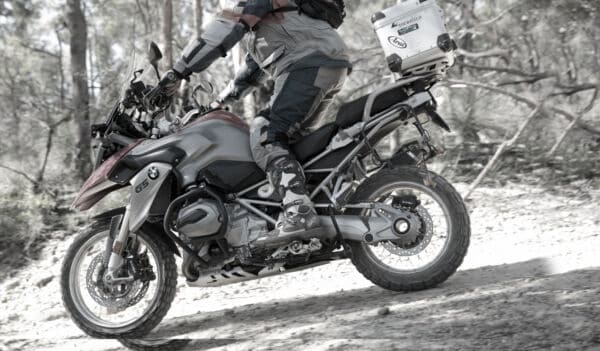
TwinPegs™ give new opportunities! With TwinPegs™, the boot pivoting around the foot peg is limited by the heel support. But the important freedom to pivot is still there. The pivoting is moved up to the ankle joint when the heel is supported by the rear foot peg. In the ankle joint we have precise feedback on position, and support muscles to manipulate the movements. This make it easier to stay in balance, receive feedback from the motorcycle and stay in control of the motorcycle. It is the natural way of standing.
With TwinPegs™, our body weight is mostly carried by our thigh muscles. The calf muscles are much less stressed. Our thigh muscles are strong, standing with slightly bent knees with heel support cost little energy. Standing with slightly bent knees is a very agile position, it makes it easy to deal with bumps and stay in balance. Downhill skiers are not using their calf muscles for “added suspension” while they are dancing on their toeballs down the slopes. They are using their thigh muscles for suspension, with firm heel support when required. Riding on TwinPegs™ works exactly the same way.
The heel support provided by TwinPegs™ makes it also easy to dynamically shift our weight in the fore/aft and side to side direction on the motorcycle, with reduced strain on our upper body while doing so. Reduced strain on the upper body reduces fatigue and “arm pump”.
Summed up: TwinPegs™ provide gained balance and control, and saves energy/ reduces fatigue. These benefits can enable a competitive rider to ride faster further, or add comfort and fun to long enduro rides or adventure journeys.
TwinPegs™ for long distance travelers
Most of us must admit that the majority of travelled miles is not in exotic vast deserts, on gnarly jungle tracks, or on endless gravelroads that twists through remote landscapes. It is on tarmac, sitting. How is TwinPegs™ relevant for long distance travelling on tarmac?
The best position for our body is always the next one. We are created for movement. TwinPegs™ make riding standing up near effortless, even at highway speeds. Standing up relaxes back and butt, and the monotony of just sitting there is broken. Good for the body, good for the mind. This make long distance travels more fun.
Buell rider Per Atle Gustafson is a hardcore long distance traveler. He rode his Buell Ulysses from Rio de Janeiro, Brazil, to Prudhoe Bay, Alaska. And back to Florida, after crisscrossing USA. With his own words:

Riding steep downhills and braking hard
Some adventure riders, that have not tested TwinPegs™, believe that riding on TwinPegs™ is a problem when riding downhill.
TwinPegs™ prototype kits are being used successfully in enduro racing in Norway, and riding downhill has not been reported as a problem once from the enduro riders. That is also my own experience, from my own enduro riding down steep descents. The grip between boots and foot pegs are very good, thus eliminating this potential problem. None of the TwinPegs™ customers and testriders have reported problems when riding downhill either.
Motocross racers often drop their heels below the primary foot peg height while braking hard, and TwinPegs™ prevents this. Thus it is natural to think that this is a major conceptual problem with TwinPegs™. For the extreme sport of motocross, more testing must be done to conclude whether TwinPegs™ is a benefit all aspects considered, or not. Landing stable on TwinPegs™ is at least much safer than landing on single pegs.
However, the grip between boot and foot pegs are very good. And it is of course possible to drop the heel below the level of the rear foot peg.
Braking has not been reported to be a problem from any enduro racer, or adventure rider.


